The hook
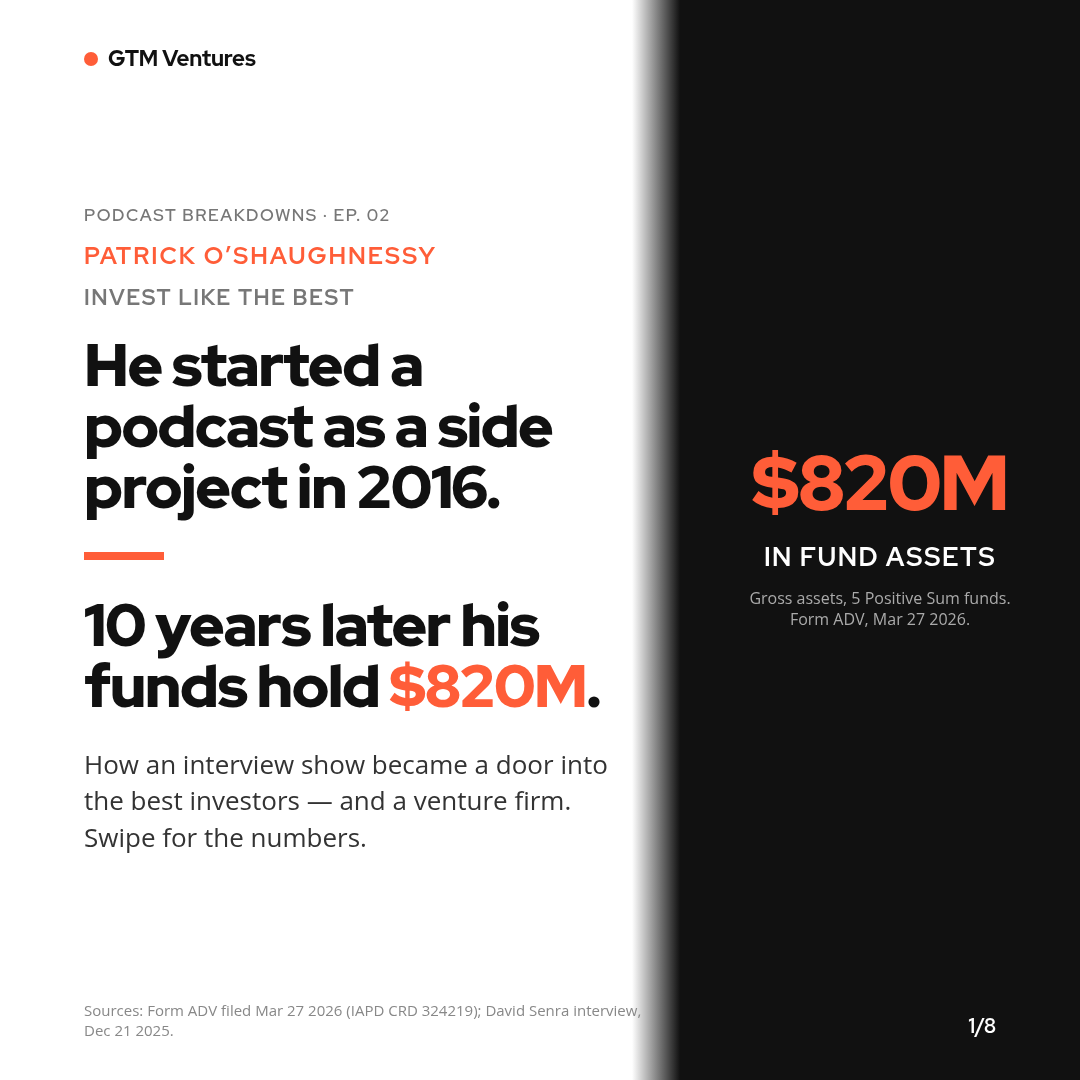
Patrick O’Shaughnessy started Invest Like the Best as a side project in 2016. No capital for the show. No team. Ten years later his firm, Positive Sum, reports $820M in gross fund assets. This is episode 2 of Podcast Breakdowns, where we take one host apart: what the show actually made, and why it worked.
The grind
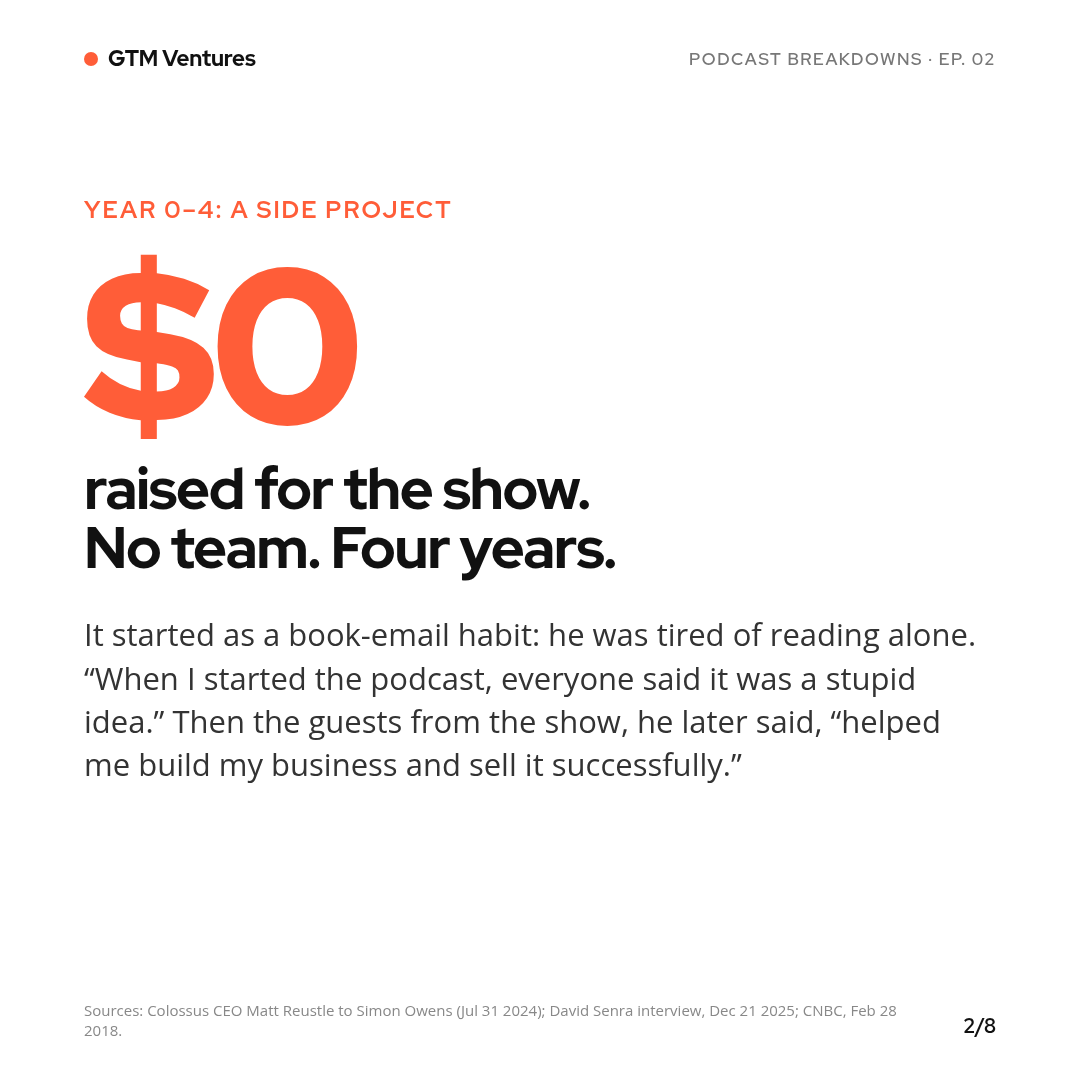
He was not trying to raise a fund. He was tired of reading alone, and he wanted to talk to people whose work he already admired. The first audience came from a book-email habit, about 100 titles a year. The first episode, on 12 September 2016, was with Jeff Gramm.
He raised $0 for the show. He had no team. It stayed a side project for four years. His line for the start: “When I started the podcast, everyone said it was a stupid idea.” Colossus, the company he founded in 2020, has described the media as a side project that became very successful.
He has said the email list gave him the first listeners, and the podcast introduced him to the people who helped him build his business and sell it. The sale price of that business is not public. We don’t treat the acquired firm’s assets as a result of the show.
The timeline
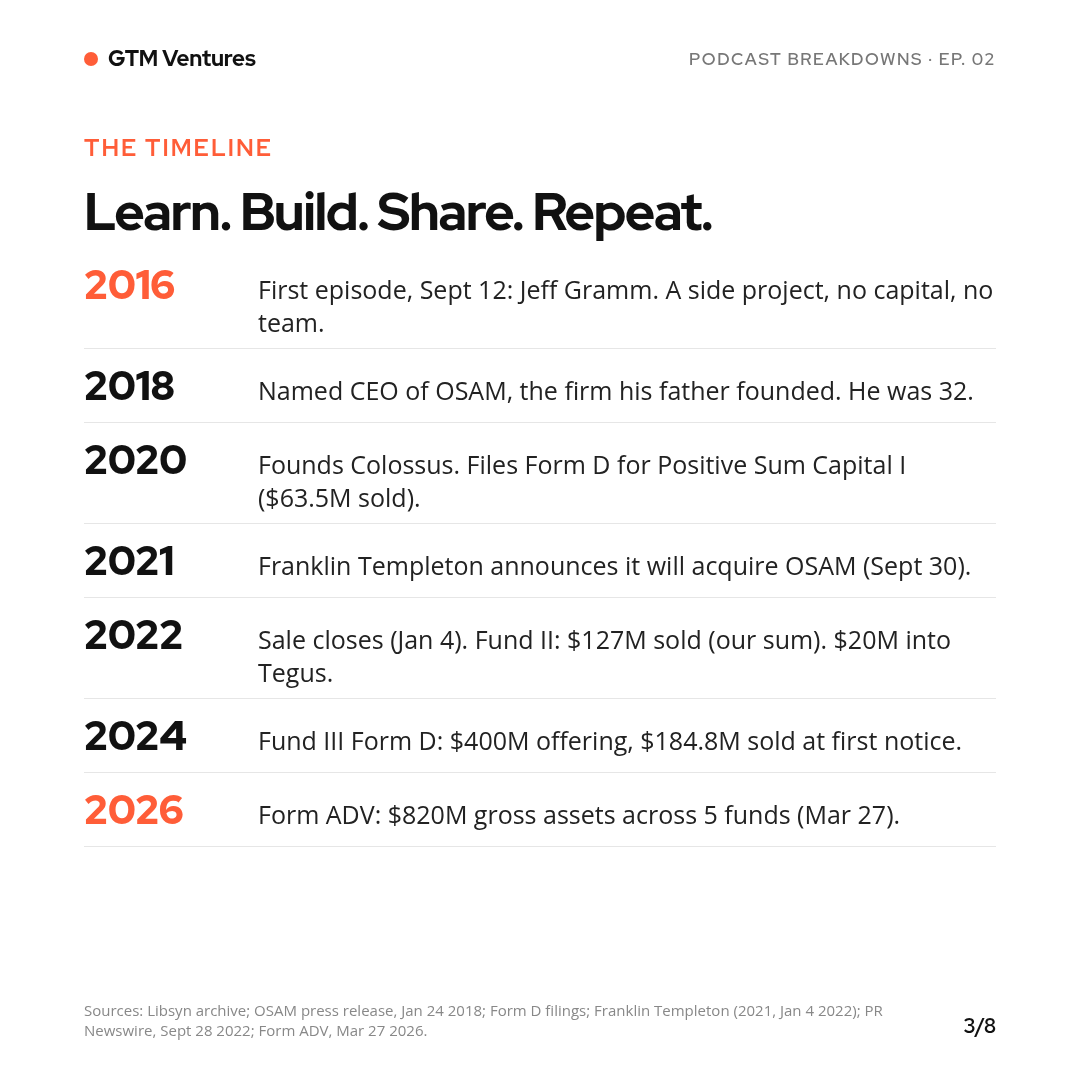
- 2016First episode, 12 September, with Jeff Gramm. A side project. No capital. No team.
- 2018Named CEO of OSAM, the firm his father founded. Announced 24 January. He was 32. The transition was done by the end of March.
- 2020Founds Colossus. Files a Form D for Positive Sum Capital I: a $125M offering, $63.5M sold, first sale 9 October.
- 2021Franklin Templeton announces, on 30 September, that it will acquire OSAM. The purchase price was not disclosed.
- 2022The sale closes on 4 January. Fund II: $127.0M sold, our sum of the QP and AA vehicles. $20M into Tegus, with a board observer seat and a formal partnership with the show.
- 2024Fund III Form D, filed 12 December: a $400M offering, $184.8M sold at that notice. Signed by Patrick W. O’Shaughnessy.
- 2026Form ADV, filed 27 March: $820M gross asset value across 5 private funds. Fund IV’s Form D, filed 12 August, is a $400M offering with $0 sold at filing. That $0 is not counted as money raised.
The money
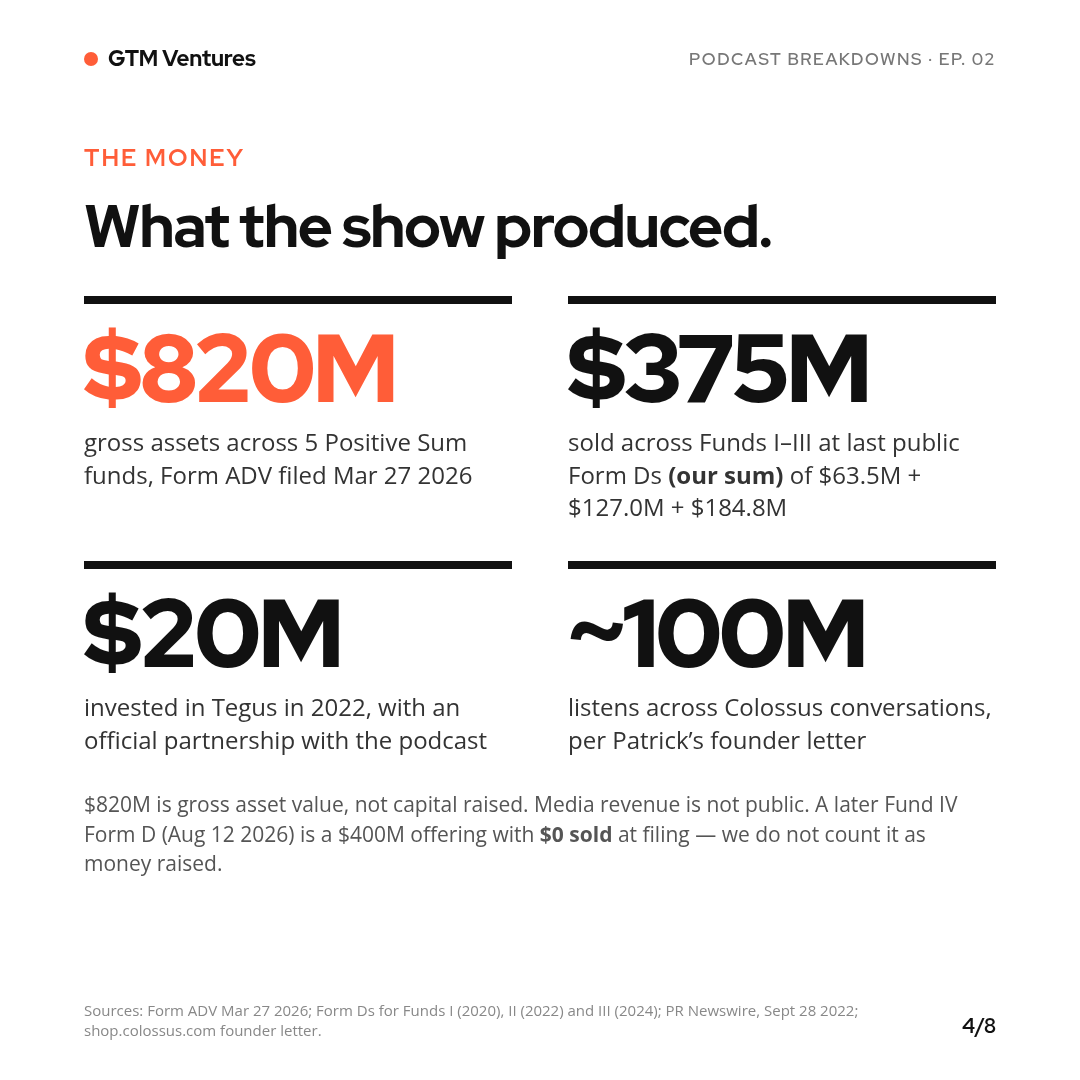
The last public Form D “total amount sold” figures for Funds I to III are $63.5M, $127.0M and $184.8M. Add them and you get $375M raised across Funds I–III Our sum. of Form D filings: $63,500,000 + $118,521,000 + $8,500,000 + $184,750,000. Fund II’s $127.0M is itself our sum of the QP and AA vehicles. These are amounts sold at each filing, not audited closes. Two other vehicles, and Fund IV’s $0 sold, are not in the sum.
Positive Sum Advisors’ Form ADV, filed 27 March 2026, reports $820M Gross asset value. on Form ADV, across 5 private funds. The exact filing figure is $820,238,333. Assets, not capital raised. It can include appreciation and money that arrived after a Form D. We do not treat it as capital he raised.
In September 2022 Positive Sum invested $20M in Tegus. He joined the board as an observer, and the firm announced a formal partnership with Invest Like the Best. Tegus was later acquired by AlphaSense. That $20M is a check, not a fund close.
Podcast revenue for Invest Like the Best and Colossus is not public. On listens, he has written that listeners tuned in ~100M listens Patrick’s own figure. covering Colossus conversations, not Invest Like the Best alone. The letter says “nearly 100 million times.”
Who the show put him in front of
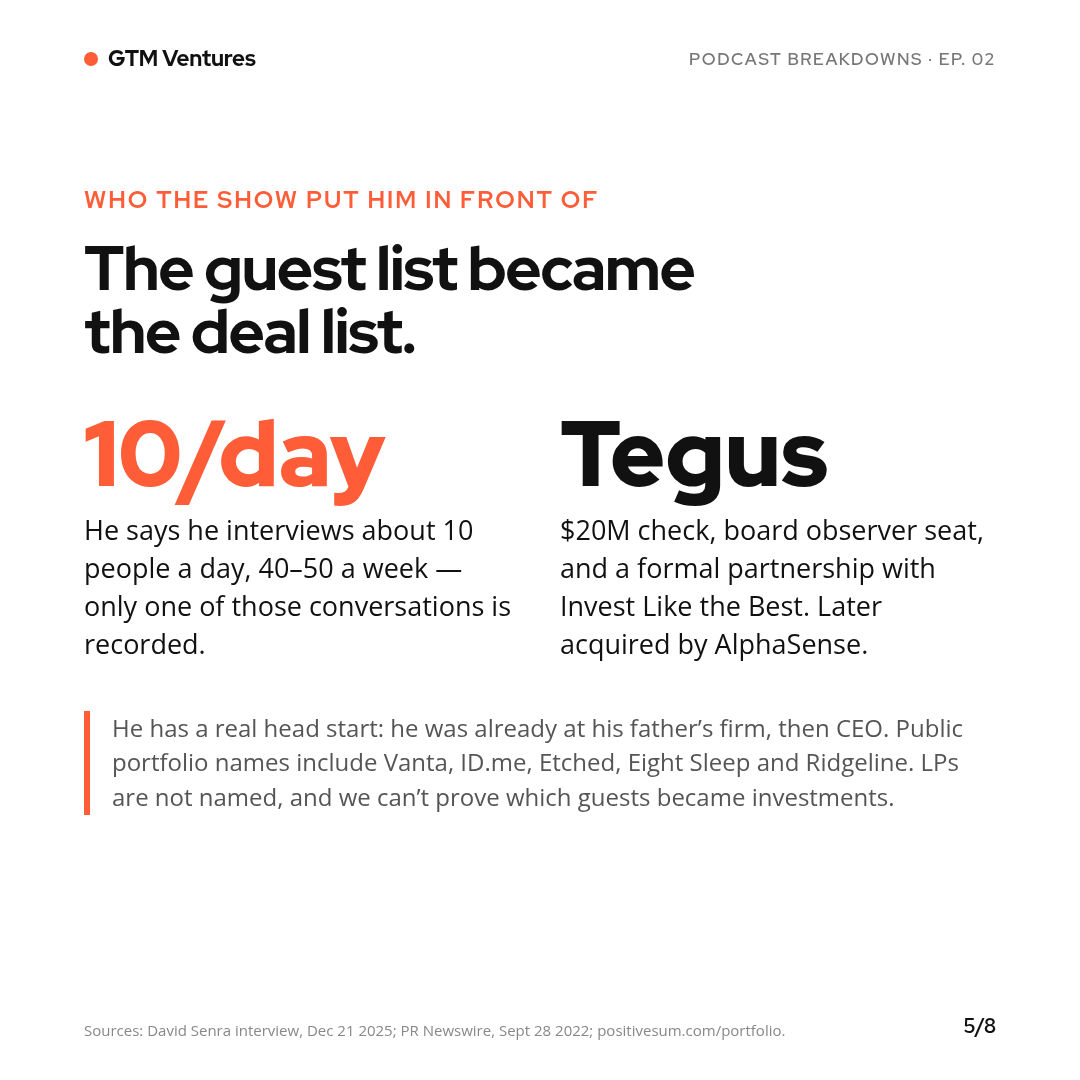
He says he interviews about 10 people a day, 40 or 50 times a week, and that only one of those conversations is the recorded episode. Daniel Ek taught him how to build software. Chetan Puttagunta of Benchmark taught him how to sell it. He says the useful advice mostly happened offline, after the mics.
The public portfolio includes Tegus, Vanta, ID.me, Etched, Eight Sleep and Ridgeline. LPs are not named. The Tegus partnership is on a press release. Which other guests became investments is not something we can prove.
He also had a real head start. He has described it as being born on third base: he was already at his father’s firm, then its CEO. The show did not create that. It was the door he used after it.
Why it worked
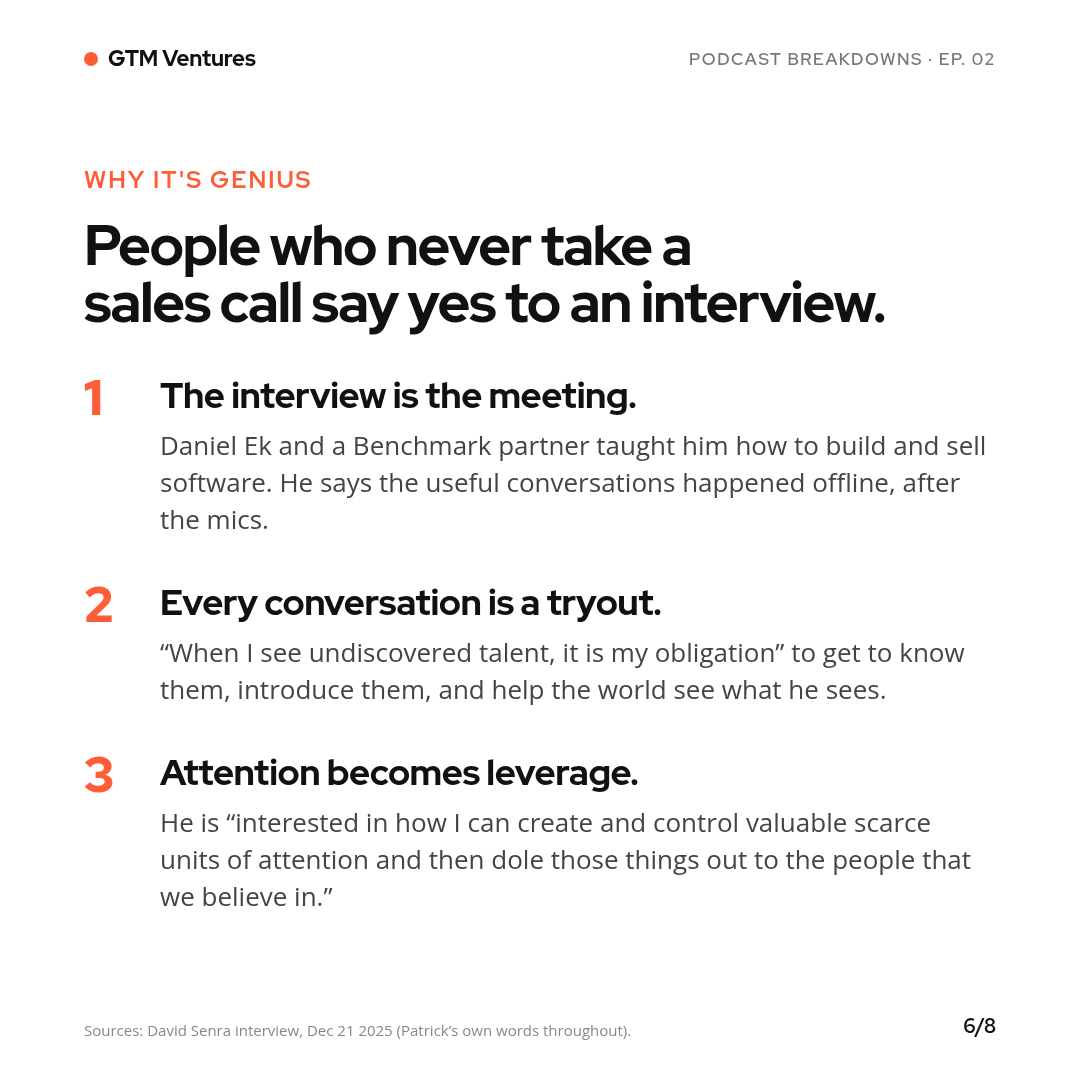
People who never take a sales call say yes to an interview. Three things made that useful. These are his words.
- 1The interview is the meeting.Daniel Ek and a Benchmark partner taught him how to build and sell software. He says the useful conversations happened offline, after the mics.
- 2Every conversation is a tryout.“When I see undiscovered talent, it is my obligation” to get to know them, introduce them, and help the world see what he sees.
- 3Attention is what he can give.He is “interested in how I can create and control valuable scarce units of attention and then dole those things out to the people that we believe in.”
What you can copy
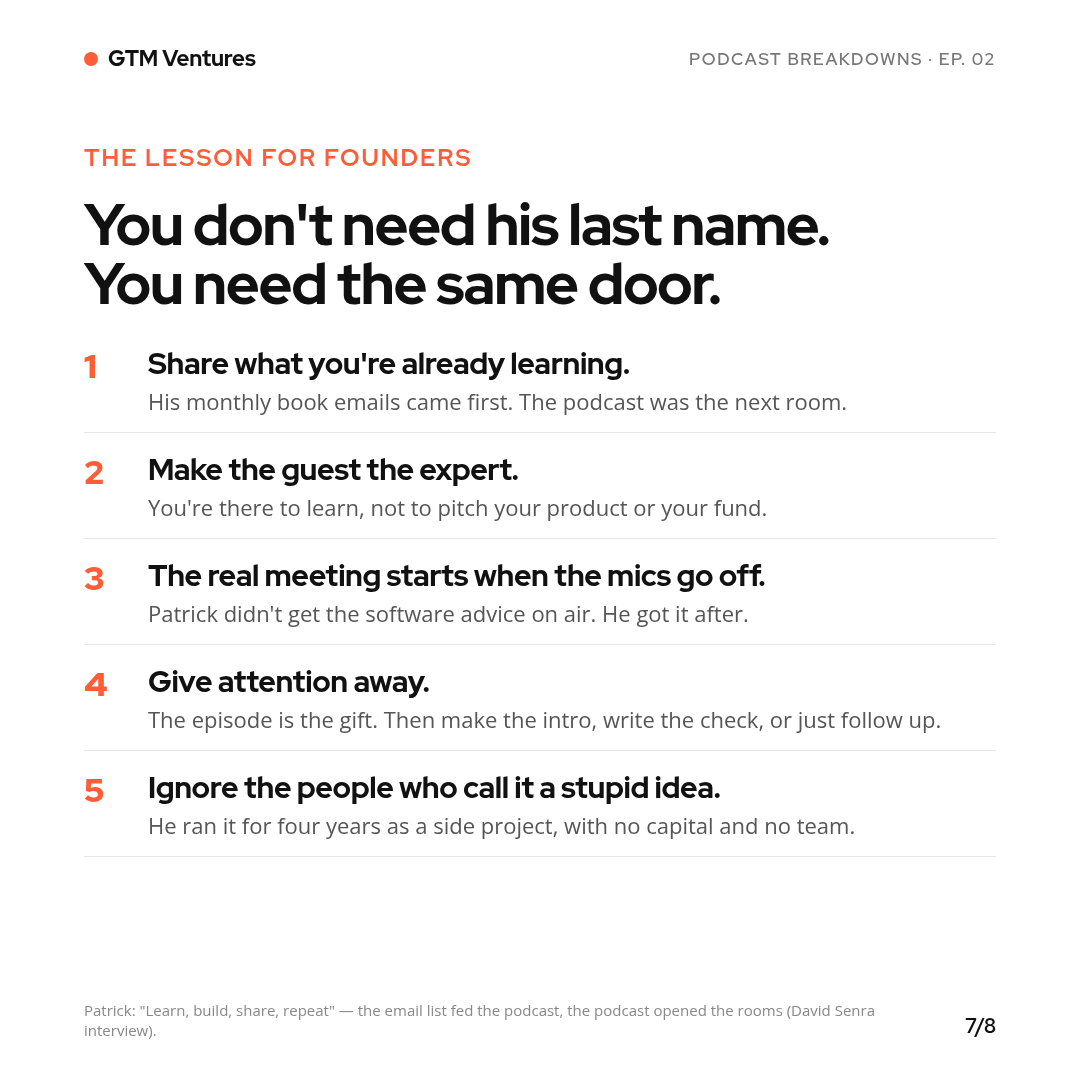
You don’t need his last name. You need the same door. Your buyers don’t take cold calls either. They do say yes to being the expert on a show.
- 1Share what you’re already learning.His monthly book emails came first. The podcast was the next room.
- 2Make the guest the expert.You’re there to learn, not to pitch your product or your fund.
- 3The real meeting starts when the mics go off.Patrick didn’t get the software advice on air. He got it after.
- 4Give attention away.The episode is the gift. Then make the intro, write the check, or just follow up.
- 5Ignore the people who call it a stupid idea.He ran it for four years as a side project, with no capital and no team.
The takeaway
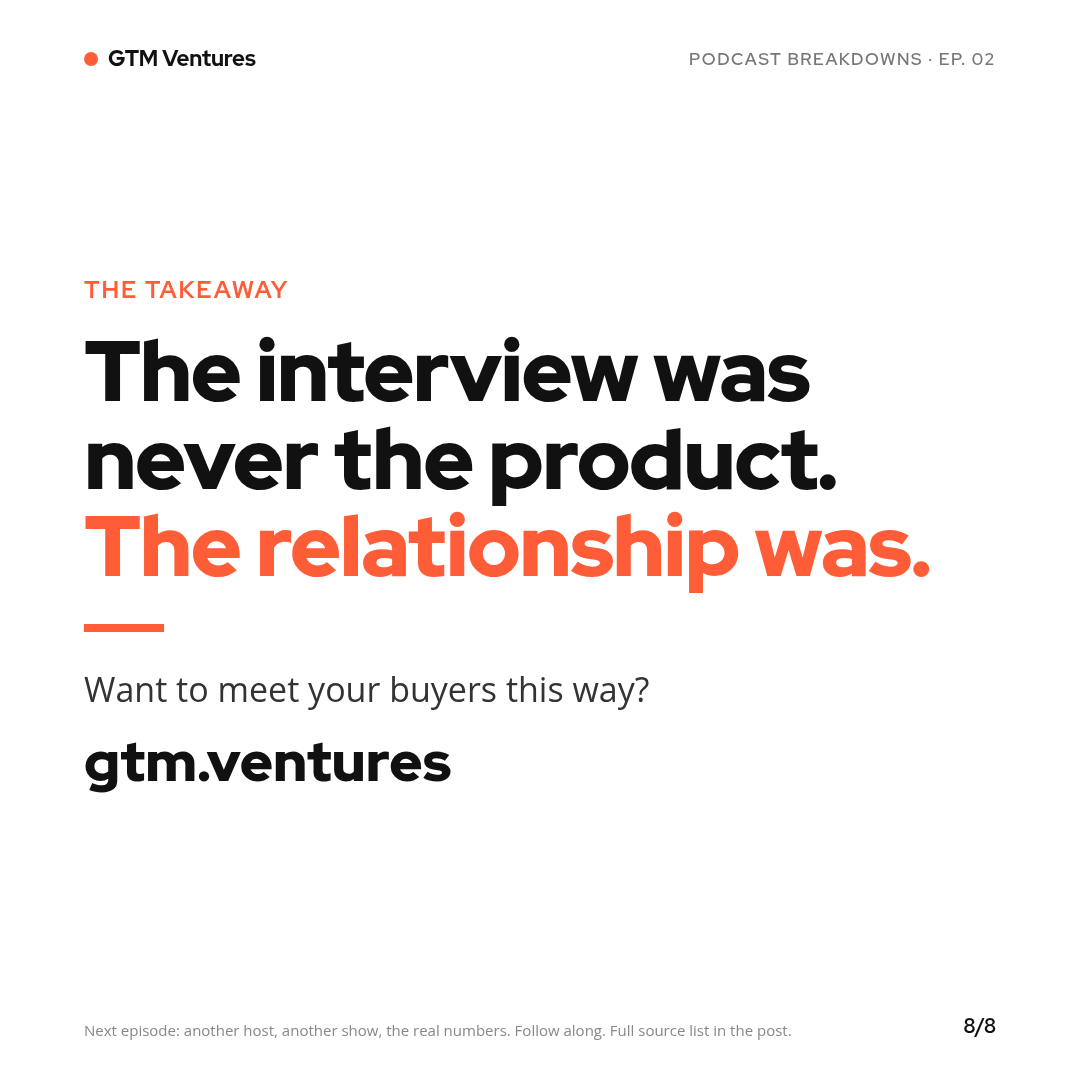
The interview was never the product. The relationship was.