The hook
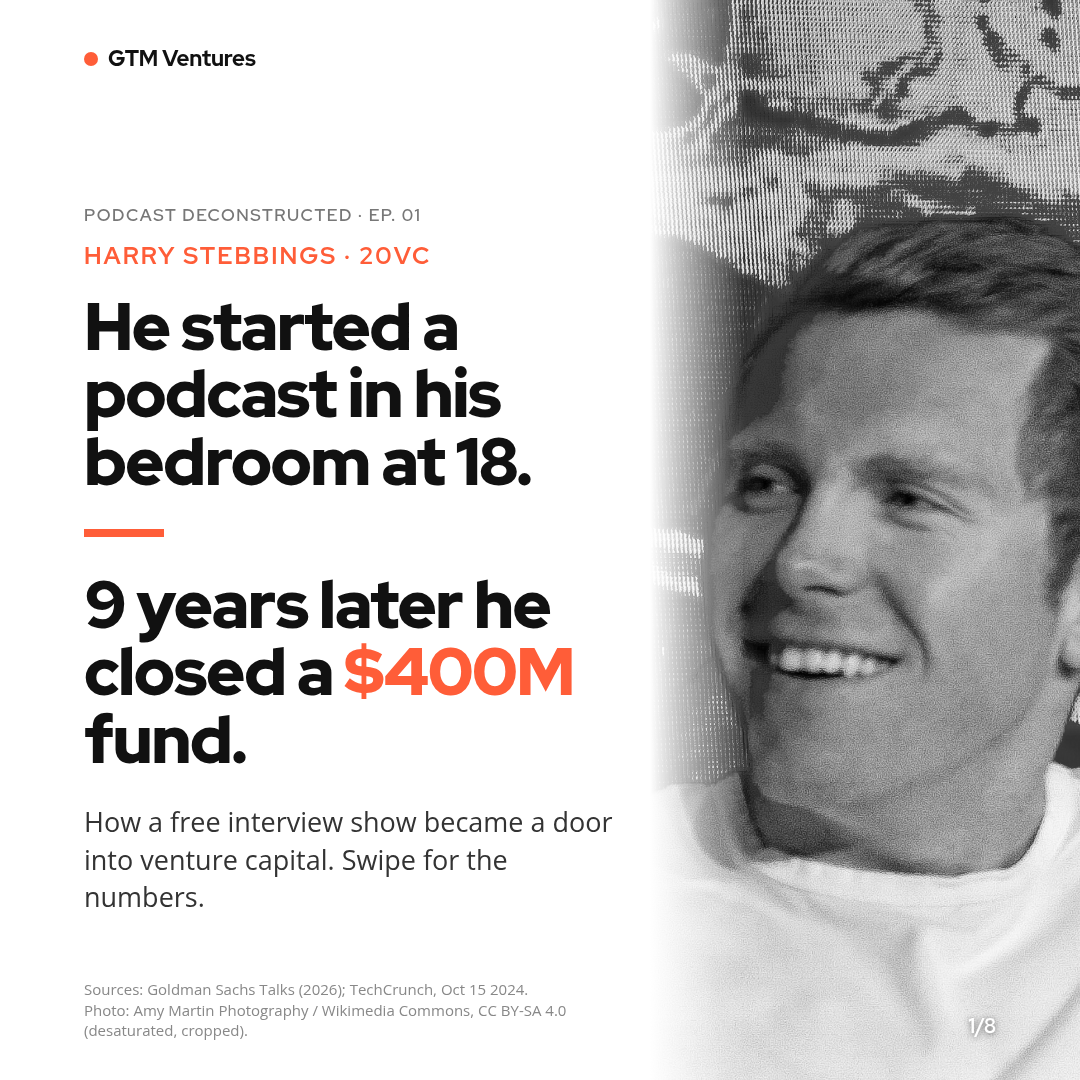
Harry Stebbings started a podcast in his bedroom at 18. Nine years later he closed a $400M fund. The show is The Twenty Minute VC. The fund is 20VC. This is episode 1 of Podcast Breakdowns, where we take one host apart: what the show actually made, and why it worked.
The grind
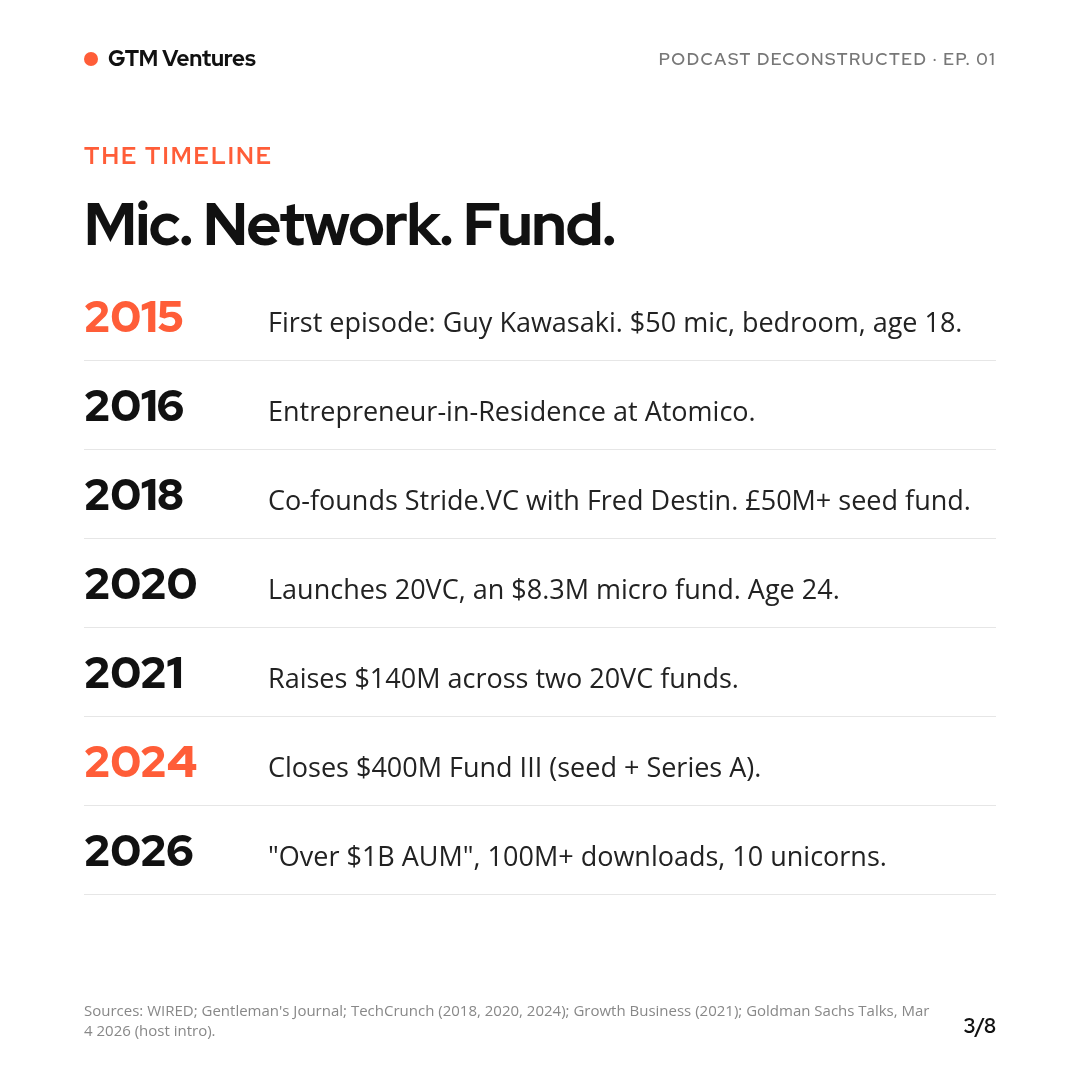
He started in 2015. The microphone cost about $50. The first episode, on 10 January 2015, was with Guy Kawasaki.
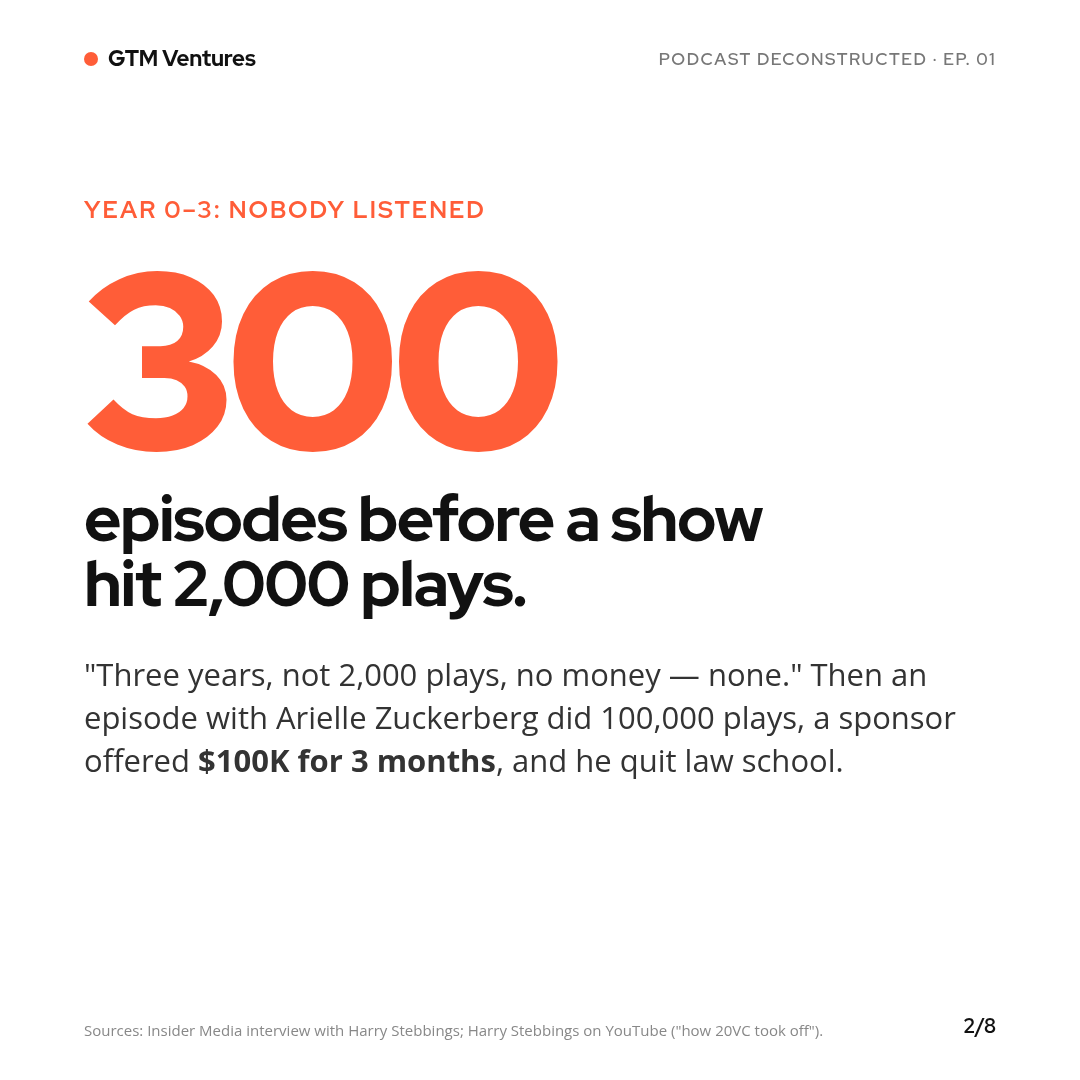
For three years the show was not a hit. He recorded about 300 episodes before a single one reached 2,000 plays. His line for it: “Three years, not 2,000 plays, no money.”
An episode with Arielle Zuckerberg did 100,000 plays. A sponsor offered $100,000 for three months. He left law school.
He kept going because the downloads were not the point. The guests were. VCs, founders and LPs who would not take a meeting with an 18-year-old law student would sit for an interview. Exposure for them. Good questions. No pitch. The show has since passed 1,400 episodes.
The timeline
- 2015First episode, 10 January, with Guy Kawasaki. About $50 for the microphone, a bedroom, age 18.
- 2016Entrepreneur-in-residence at Atomico, from the end of the year.
- 2018Co-founds Stride.VC with Fred Destin. A £50M+ seed fund. He left Stride in February 2021.
- 2020Launches 20VC, an $8.3M micro fund, at 24.
- 2021Raises $140M across two 20VC funds: $33M seed and $107M.
- 2024Closes $400M Fund III on 15 October: $125M seed and $275M Series A.
- 2026A Goldman Sachs host intro on 4 March says “over $1B” in assets, 100M+ downloads and 10 unicorns. No audited assets figure is public. No Fund IV had been announced as of 10 November 2026.
He says the $400M came together in about eight weeks, after 3 to 4 years of building relationships with no expected return. The eight weeks are his account to Insider Media. TechCrunch reported four weeks. PitchBook and Forbes reported four months.
The money
The published 20VC closes are an $8.3M micro fund in July 2020, $140M across two funds in 2021, and $400M Fund III in October 2024.
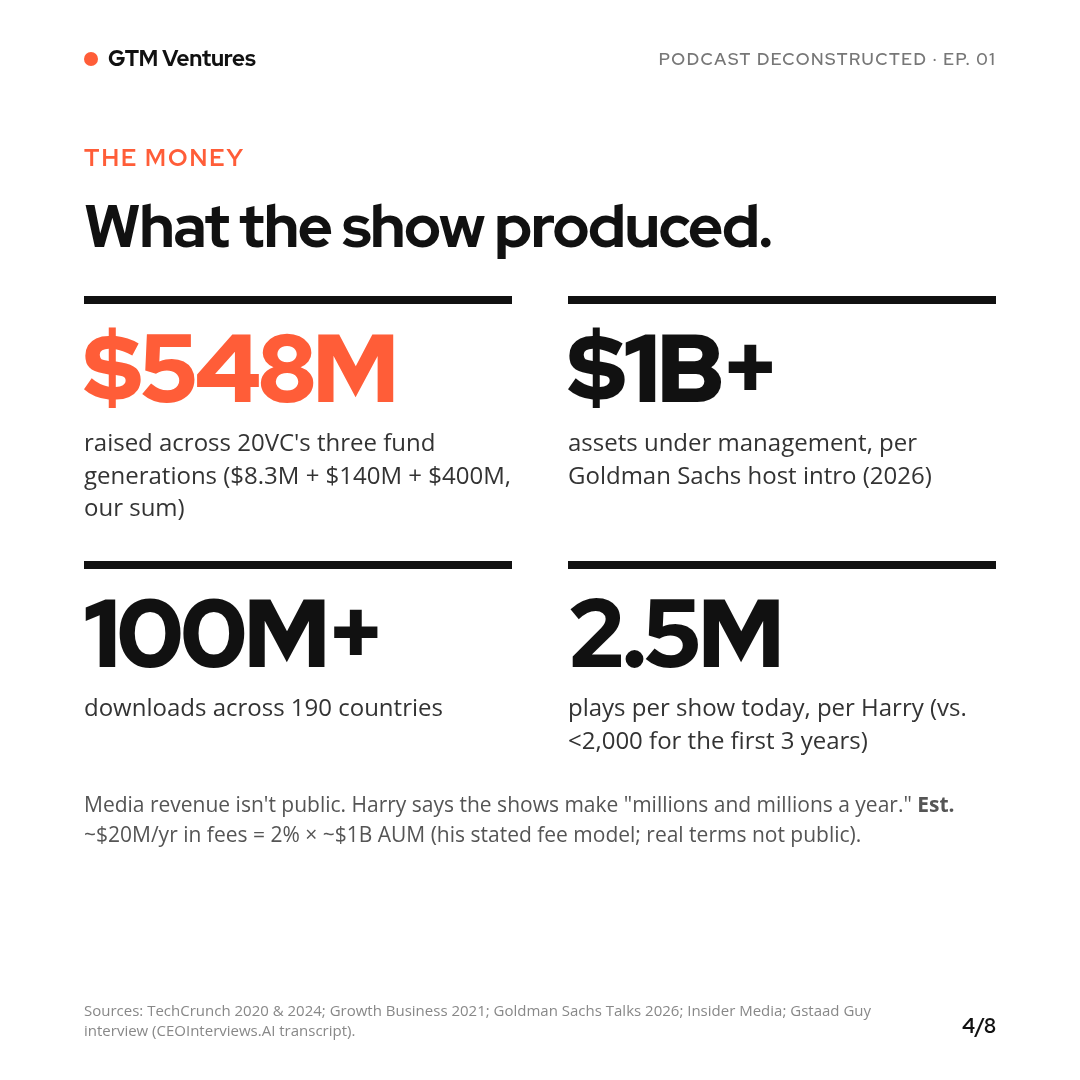
Add those three and you get $548M across the three 20VC funds Estimate. That is our sum of $8.3M, $140M and $400M. 20VC has not published that total. Stride.VC, the £50M+ fund he co-founded, is not a 20VC fund and is not in the sum.
Assets under management are “over $1B”, from the Goldman Sachs host intro on 4 March 2026, and “about a billion dollars” in his own words. That is not an audited figure. Downloads are past 100 million, across 190 countries, in that same introduction. He says a show now does 2.5 million plays, against under 2,000 for the first three years.
Podcast revenue is not public. He says the shows make “millions and millions a year”, and that the podcast now makes more money than anything else.
On the fee rate he has described, 2% of about $1B under management comes to ~$20M/yr in fees Estimate. The 2% management fee and 20% carry are the rates he has described, and the assets figure is the one above, not an audit. Actual fee terms, whether the fee is on committed or invested capital, and any step-downs are not public.
Who backed the fund
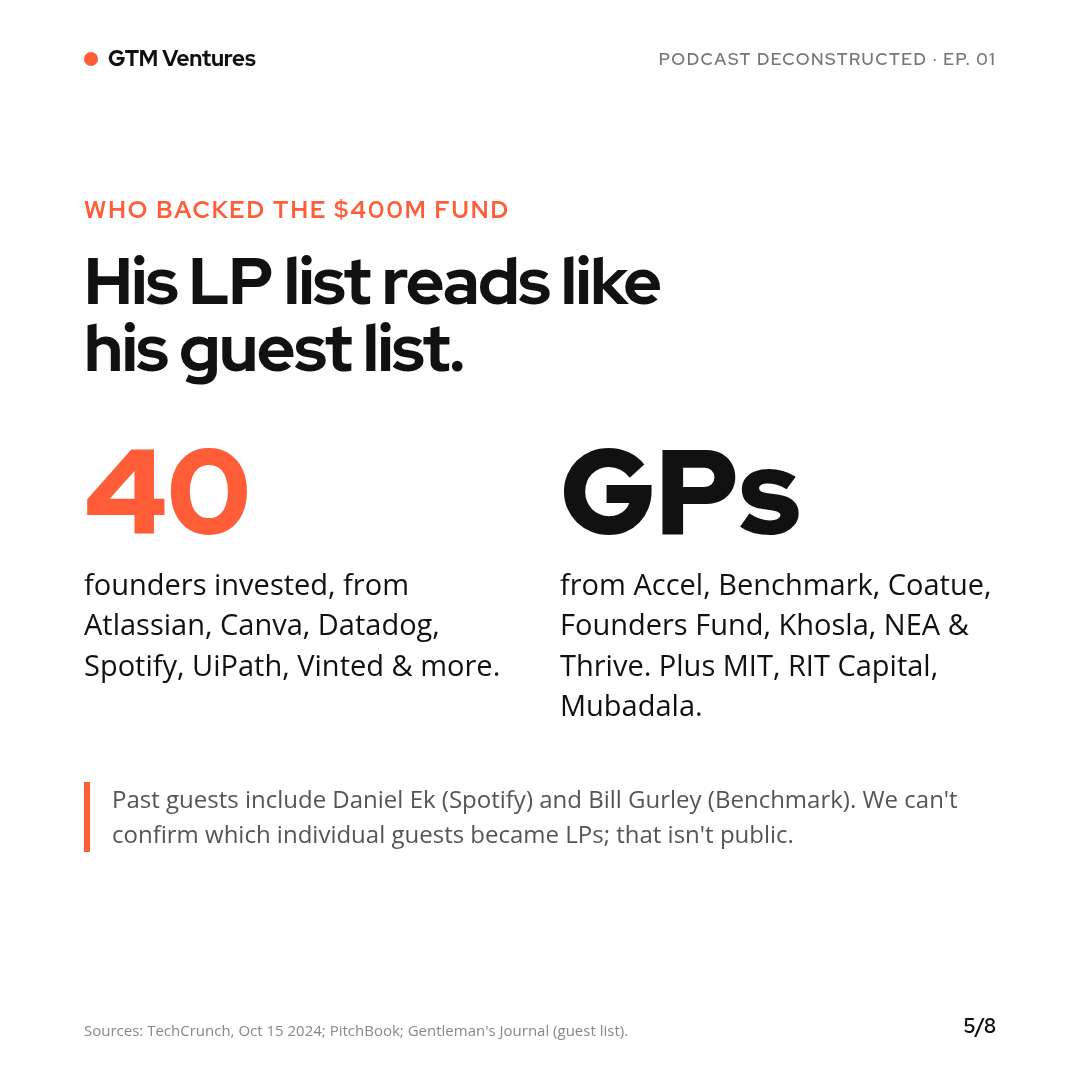
Forty founders invested in the $400M fund, from companies including Atlassian, Canva, Datadog, Spotify, UiPath and Vinted. GPs came from Accel, Benchmark, Coatue, Founders Fund, Khosla, NEA and Thrive. MIT, RIT Capital and Mubadala are in the LP base. PitchBook reported that about half the fund came from US LPs.
Past guests include Daniel Ek, Reid Hoffman, Bill Gurley, Doug Leone and Howard Marks. TechCrunch names the companies whose founders invested, not the people. Which individual guests became LPs is not public.
He told Forbes he cold-emailed Marc Benioff 53 times, and that he meets two new LPs a week. His line to PitchBook: “We’re a venture fund tied to a media business.”
Why it worked
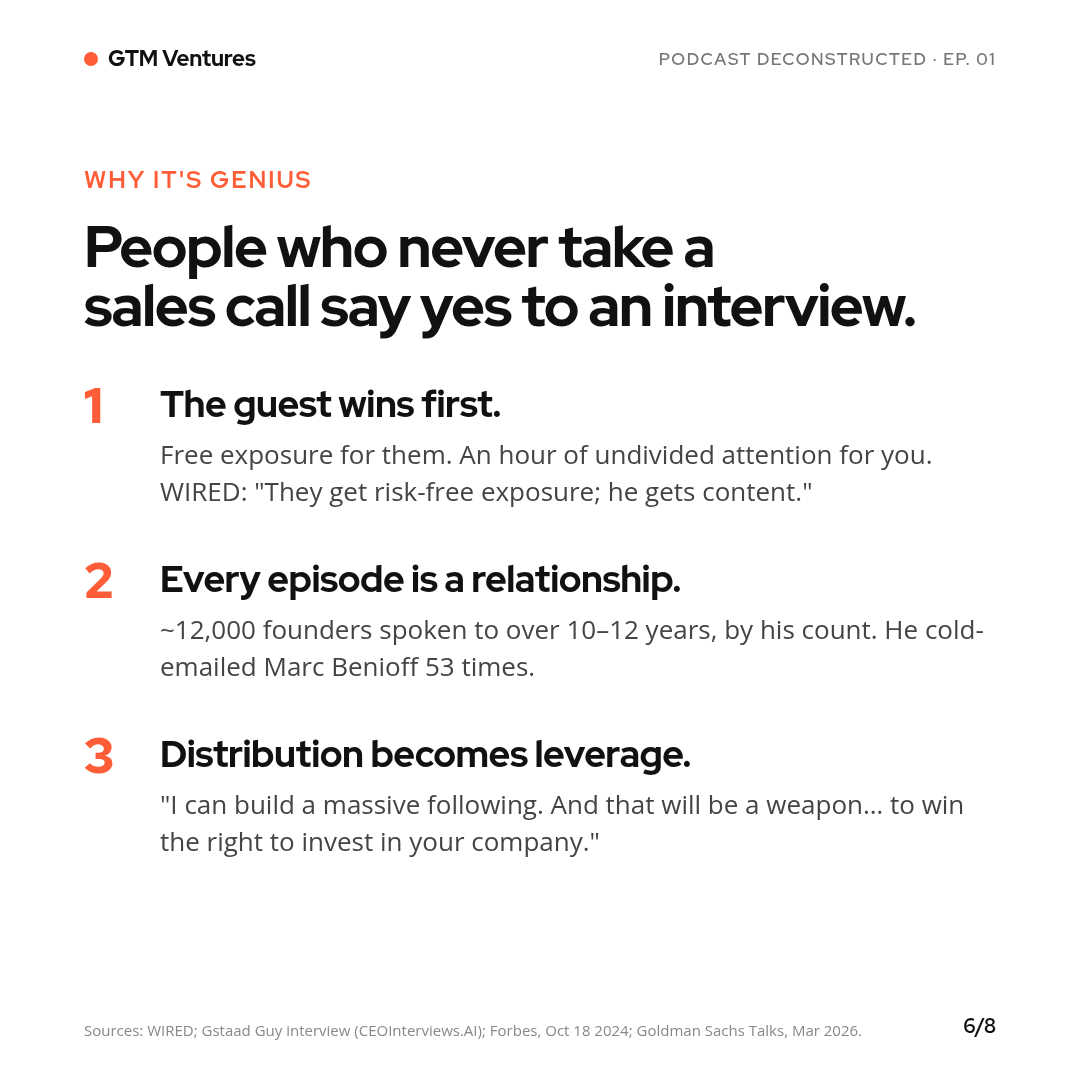
People who never take a sales call say yes to an interview. Three things made that useful.
- 1The guest wins first.The guest gets the exposure. An hour of undivided attention for him. WIRED: they get the exposure, he gets the content.
- 2Every episode is a relationship.About 12,000 founders over 10 to 12 years, by his count. He cold-emailed Marc Benioff 53 times.
- 3The following is the door.On the Goldman Sachs stage: “I can build a massive following. And that will be a weapon… to win the right to invest in your company.”
What you can copy
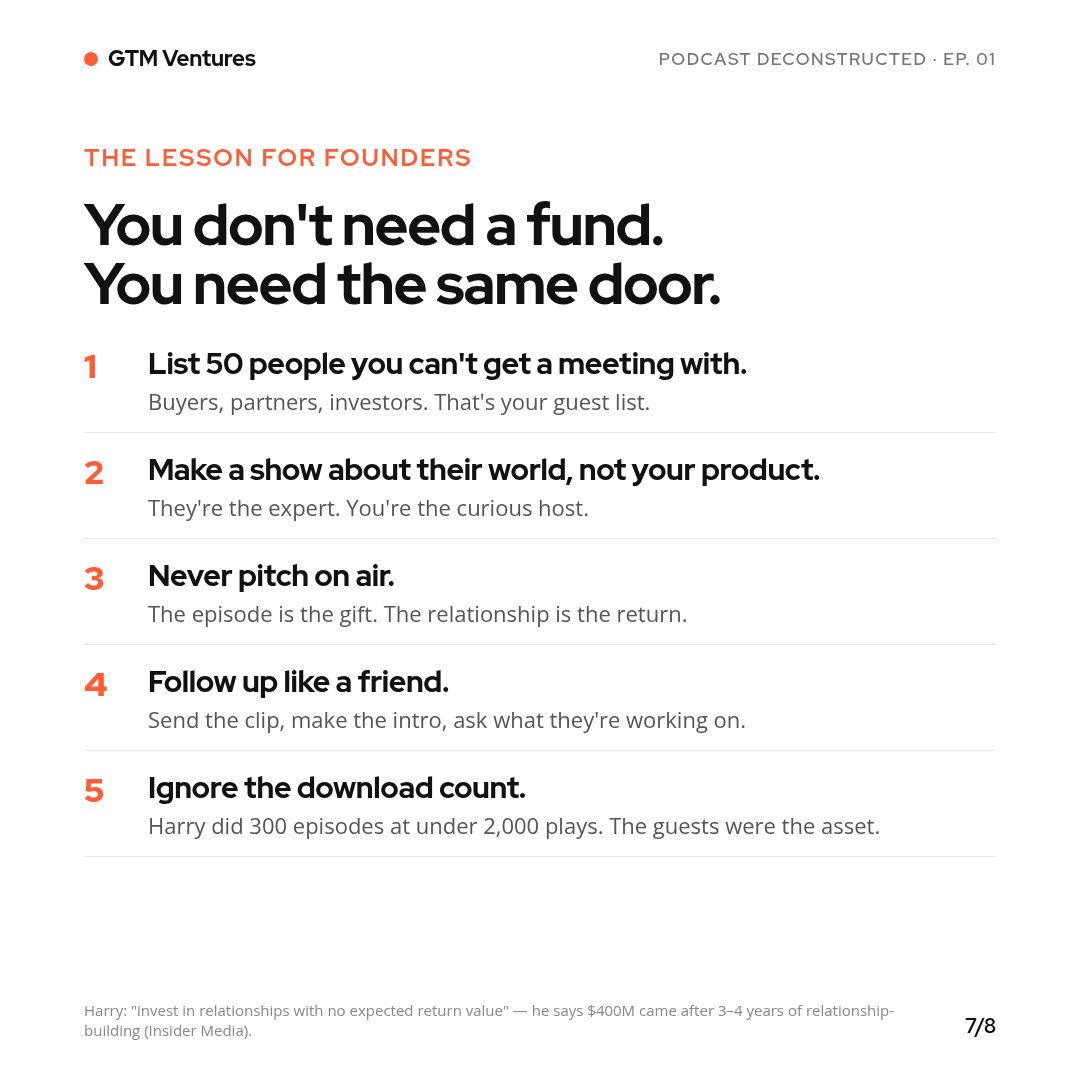
You don’t need a fund. You need the same door. Your buyers don’t take cold calls either. They do say yes to being the expert on a show.
- 1List 50 people you can’t get a meeting with.Buyers, partners, investors. That’s your guest list.
- 2Make a show about their world, not your product.They’re the expert. You’re the curious host.
- 3Never pitch on air.The episode is the gift. The relationship is the return.
- 4Follow up like a friend.Send the clip, make the intro, ask what they’re working on.
- 5Ignore the download count.Harry did about 300 episodes under 2,000 plays. The guests were the asset.
The takeaway
The podcast was never the product. The guest list was.